Former first lady, tycoon and ‘safe pair of hands’ for power
Nicholas Negos,BBC Africa, Abidjan And
Chiagoji Nwonwu,BBC Africa

 Reuters
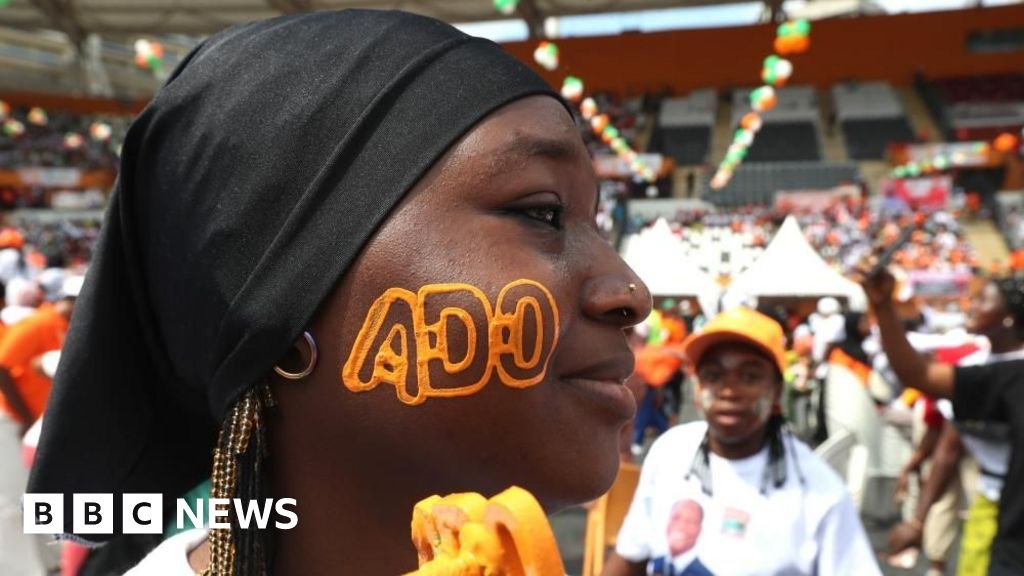
Dance dominates campaign rallies in Ivory Coast, but the energetic energy and enthusiasm is worrying about the political landscape in the world’s biggest cocoa-producing country.
Saturday’s presidential vote in the West African nation is as significant for candidates vying for the top job as it is for a ban on electing candidates.
While incumbent President Alasane Ouattara, a hero to some for bringing the country to growth in the past 15 years after a brutal civil war, the 83-year-old’s bid for a fourth term is drawing backlash from those who see it as a slap in the face of democracy – even though his candidacy is allowed by the constitution.
Prominent opposition leader Tidjene Thiam was disqualified in April after a court ruled he had lost his Ivorian citizenship when he became French in 1987 – a decision he disputed – while former president Laurent Gbagbo was banned due to a 2018 criminal conviction.
Gbagbo’s refusal to concede defeat to Ouattara in a run-off vote in 2010 sparked a post-election conflict that left more than 3,000 dead and shocked a nation crucial to the world supply of chocolate.
Yet Ouattara, known to his supporters by his initials, “Ado”, still faces strong competition, particularly from Gbagbo’s ex-wife, and one of the country’s richest men, is popular with urban voters – but remains a divided opposition.
There are four candidates against the octogenarian:
- Simone GagboThe former first lady, 76, was once married to former president Laurent Gbagbo and is considered his chief adviser.
- Jean-Louis Billon60, a former minister and one of the country’s richest men who made his fortune from palm oil
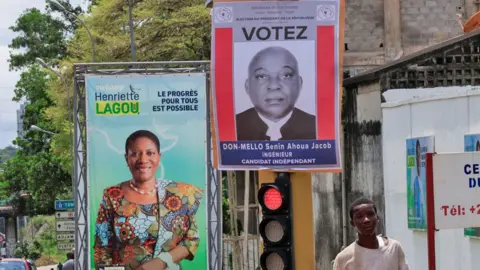
- Henriette Lagou Adjoua66, former minister and prominent women’s rights campaigner
- Ahoua Don Melo67, former minister and former colleague of former President Gbagbo.
 AFP/Getty Images
Despite economic progress under Ouattara, his opponents hope to capitalize on the grievances of many of the country’s poor, who have not felt the benefits of rapid growth.
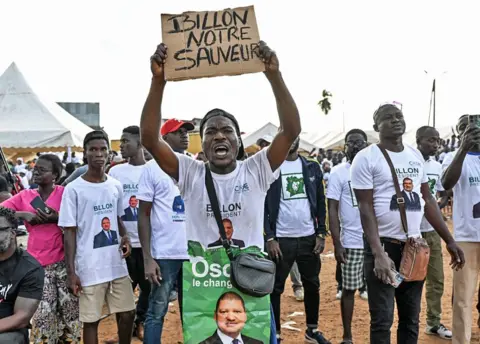
“The economy is growing, but not for us,” Billon, a business tycoon and the youngest of all the candidates – representing the Democratic Congress (CODE) – has said.
Dancing on stage during a rally in front of thousands of supporters in the political capital, Yamoussoukro, he performed judo moves to show he was “ready for the job and full of energy”.
“Young people are not getting jobs and the cost of living is going up,” says the politician, who is convinced that “Outara’s time will be over” if he runs for a second term in office.
Billon was hoping to represent the centre-right Democratic Party (PDCI) of the late president Henri Conan Bedi.
But in the end the party went with the now disqualified Thiam – so with no candidate on the ballot paper, Billon is confident he will get the support of PDCI supporters.
However, Simone Gbagbo, leader of the Left Movement of the Empowered Generation (MGC), has also positioned herself as a voice for the disaffected – and believes those votes will come to her.
 MGC
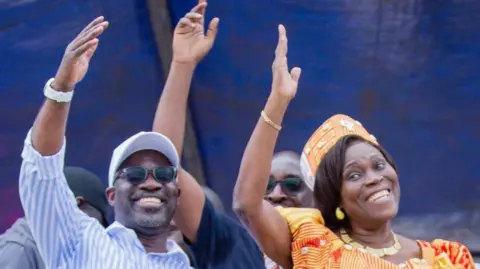
MGCAlways smiling and dressed in traditionally smart clothes, her energy shines through and she holds her mic like a pop star. A natural campaigner, she knows how to energize her supporters.
The former first lady, who was once dubbed the “Iron Lady” for her toughness, is part of the CPA-CI, a coalition of opposition groups that came together to protest Ouattara’s candidacy earlier this year.
“President Ouattara has done some good things, but he destroyed education,” she told her supporters recently.
With a background in education, academia and labor unions, her campaign has focused on rebuilding schools and providing better opportunities for young people.
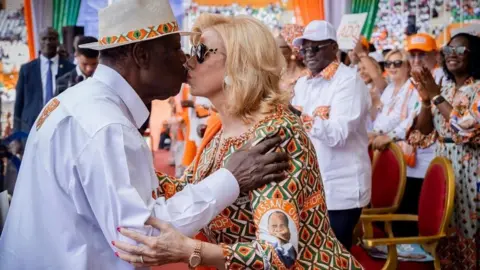
Despite such criticism, Ouattara’s supporters remain confident. His rallies seem a little less dynamic than those of 2010, 2015 and 2020 – but they still attract people of all ages.
Ivorian rapper Tam Paya’s popular hit Coup du Marteau (Hammer Blow) and Tim Paya has become an unofficial anthem of his RHDP party with former prime ministers, ministers, MPs and other influential supporters.
“The president is in good shape and ready to serve again,” says government spokesman Adama Coulibaly, pointing to major public works and investor confidence as proof of the country’s stability.
 AFP/Getty Images
But despite constitutional changes in 2016 that allowed Ouattara to run for a third and fourth term, his candidacy this time has sparked outrage and the government has responded to recent protests with a swift crackdown.
More than 700 protesters were arrested and 50 sentenced to three years in prison following a counter-protest earlier this month.
There is some concern that this could be a prelude to more post-poll unrest.
The memory of past political violence remains vivid – and to prevent any unrest, security forces have been deployed in major cities.
Still, many residents are taking precautions.
“We are leaving Abidjan a week before the vote,” Ahoua Diamande, a mother of two, told the BBC.
“Every election brings battle and death.”
But there are also optimists, like Charm Matuba, an Abidjan resident who is originally from Congo-Brazzaville and is closing in on the campaign trail even though she can’t vote.
“I know everything will be fine. Ivorians don’t want to die for politicians again,” she said.
“I hope people will go to the polls. All my friends support Simone. She is a leader, a real source of inspiration. She can surprise.”
Regional loyalties are likely to play a big role in this election as before.
 Reuters
Ouattara enjoys strong support in the north, where his base is loyal among Dioula-speaking communities – and he decided to launch his campaign in the west where he has previously taken votes.
Simone Gbagbo also draws much of her support from the West – and even from the South-West, the historic stronghold of her ex-husband’s former party.
Billon appeals to urban voters and central regions, promising to modernize the economy and promote generational change.
“He represents the younger generation,” said 19-year-old Salifou Sanogo. “It will be my first time voting and seriously, I know he will win. Ouattara is very old, tired and has done nothing for us. We need change, we need Billon.”
The endorsement of the excluded candidates would be crucial but neither Thiam nor former President Gbagbo endorsed anyone else.
However, Simone Gbagbo has been supported by Charles Blay Goude, who was once a close associate of her ex-husband and who has decided not to put his hat in the ring.
“Bring Simon to the palace,” the charismatic politician told thousands of supporters of his young patriotic COJEP party at a recent rally.
 RHDP
RHDPAlong with the economy, foreign relations have also become a campaign issue.
Ivory Coast has taken a hardline stance against military junta forces in Mali, Niger and Burkina Faso, which now form the Alliance of Sahel States (AES) and are seeking closer ties with Russia.
The regime accused Ouattara of siding with France, its former colonial power, and pursuing a “secret agenda” on its behalf – which his government denies supports democratic governance in the region.
But the rhetoric has fueled tensions with its northern neighbours. Some opposition candidates, including Ahua Don Melo, have suggested that Ivory Coast should be “open to new partnerships” with Russia and China, arguing that the country should diversify its alliances.
His message resonated in parts of western Ivory Coast, where anti-French sentiment runs deep.
Last March, when fake news alleging that Ouattara had died circulated on social media, Ivorian authorities believed it had originated in AES countries.
As the noise and excitement of the campaigns fades, President Ouattara’s supporters insist that continuity is the key to stability and economic progress.
His critics argue that another term could fuel disillusionment and erode trust in democratic institutions – which has dangerous echoes of the past.
More BBC stories on Ivory Coast:
 Getty Images/BBC
Share this content:










Post Comment